I’m probably not going to tell you anything new in this article.
You already know what it takes to make progress. You know you need a clear vision, realistic goals, good habits that support those goals, and systems that help you stay consistent. None of this is new information.
But if you keep reading, you will see something differently. Something simple, but deeply transformative in the way I will share my thoughts about making progress.
This article is about one central idea: progress begins the moment you stop trying to control everything around you.
You may be protesting in your mind right now saying:“I don’t try to control things,” or “this doesn’t apply to me.”
But it does.
And it shows up more often than you realize. Keep reading, and I will show you.
What is Progress?
Most people confuse progress with change. Change is like movement, it is direction-neutral. You could be moving and still be heading in the wrong direction.
But making progress is not just about moving. At its core, progress is the process of moving toward a desired state through measurable improvement, learning, or development over time. It implies both direction and intention.
From an evidence-based perspective, progress has three defining characteristics. It is movement toward a clearly defined objective, even when that movement is small. It reflects an improvement in your capability, condition, or capacity to live the life you desire. And it involves learning, adapting, and becoming more effective over time, even when results are not immediate.
In simple terms, progress is forward movement with evidence of growth, whether in your clarity, competence, discipline, impact, or understanding.
This distinction matters because many people abandon worthwhile paths when results are slow, mistaking development for a lack of progress. Evidence consistently shows that sustained progress is often nonlinear, cumulative, and only visible in retrospect (Amabile & Kramer, 2011; Clear, 2018). Meaning, just because you do not see immediate results does not mean nothing is happening.
But I am willing to bet you already knew that.
So let’s take this a step further: if you already understand what progress is and what it requires, why are you still stuck?
There are two major reasons.
The first is strictly scientific. The second is more subtle.
In behavioral science, the Fogg Behavior Model explains that action depends on the interaction between motivation, ability, and triggers (Fogg, 2009).
- Motivation – is the purpose or reason why you want to do the action
- Ability – is the ease or capacity to actually do it.
- Trigger – is a clear cue that signals it is time to act.
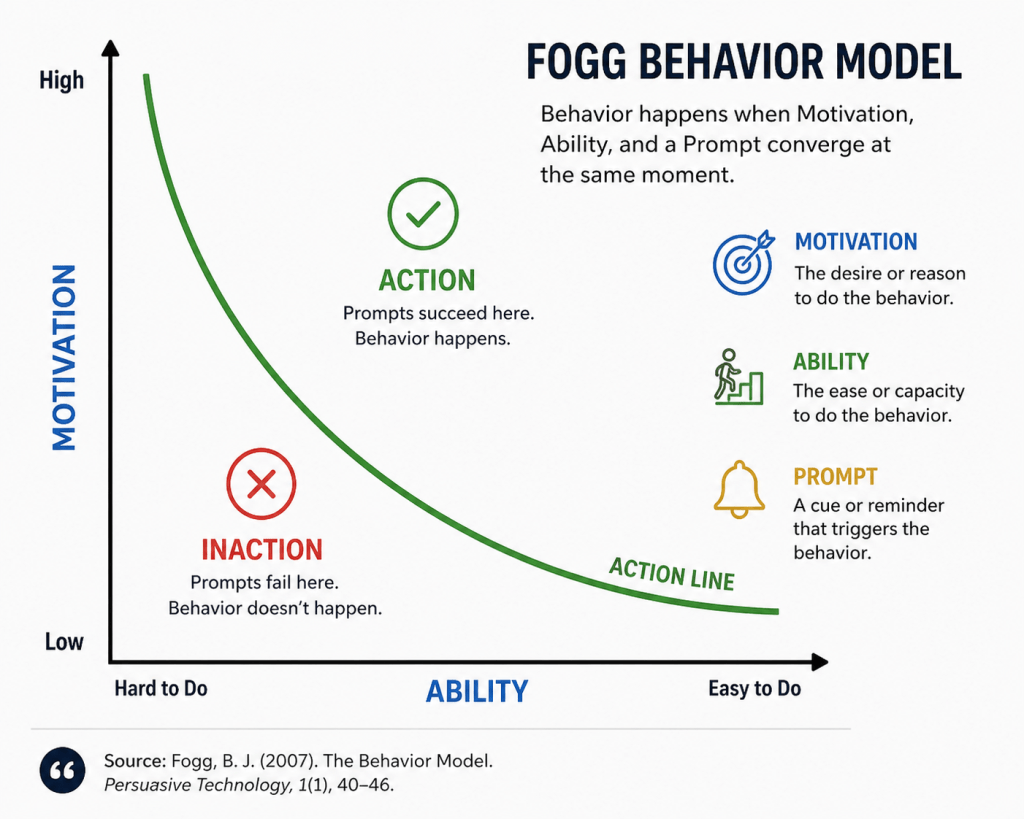
When you ensure these three elements are in place, action becomes much easier. When they are not, even simple tasks can feel difficult to start or sustain. This is the scientific explanation for why we act or fail to act.
A practical example
Recently, I had some deadlines to meet on my academic journey. I needed to submit the first draft of my dissertation by a specific time. Missing it would have affected my entire academic timeline. For three weeks straight, I worked on my paper every single day, sometimes for as long as twenty hours. My motivation was clear. I needed to submit on time to stay on track. The ability was not a barrier because I knew how to write. And the triggers were present in my environment: my alarm clock, my computer always open on my desk, and a calendar reminding me how little time I had left.
I was able to successfully complete everything on time because of this simple system.

Having the right motivation, ability and triggers is the simplest system that gets people moving every time.
But beneath that, there is something deeper that often gets overlooked: the need for control.
At its core, the need for control is the desire to feel secure by managing outcomes, people, and situations. It is a very human instinct. We want to predict what will happen, influence how others respond, and shape our environment so things go our way. But when this need for control becomes excessive, it does not move us forward, it keeps us stuck.
It shows up in ways that are easy to miss.
Every time you overplan, micromanage, or try to be perfect, that is control. Every time you give up because something feels too hard, that is also control. Every time you get upset or offended by someone’s response, that too is control. In all of these moments, you are trying to control something outside of yourself. You are trying to control outcomes, situations, or people. And when those things do not go your way, you withdraw, hesitate, or give up.
Most of us try to control these external things because we have not yet learned to control ourselves. It is easier to focus on what others are doing than to confront our own patterns. We struggle to regulate our emotions, our discipline, and our reactions. So instead, we compare ourselves to others and use that comparison as a measure of progress.
But progress is not measured by how far you have come compared to someone else. It is measured by how far you have come compared to who you used to be.
Here is the truth. You do not have control over people, outcomes, or most situations. What you do have control over is how you think, how you act, and what you do consistently.
The real power to progress lies in your ability to let go of control. The day you realize that the only power you truly have is over your own thoughts, feelings, and actions is the day your life begins to change. When you stop trying to control everything around you, you free yourself to work on the only thing that truly matters: yourself.
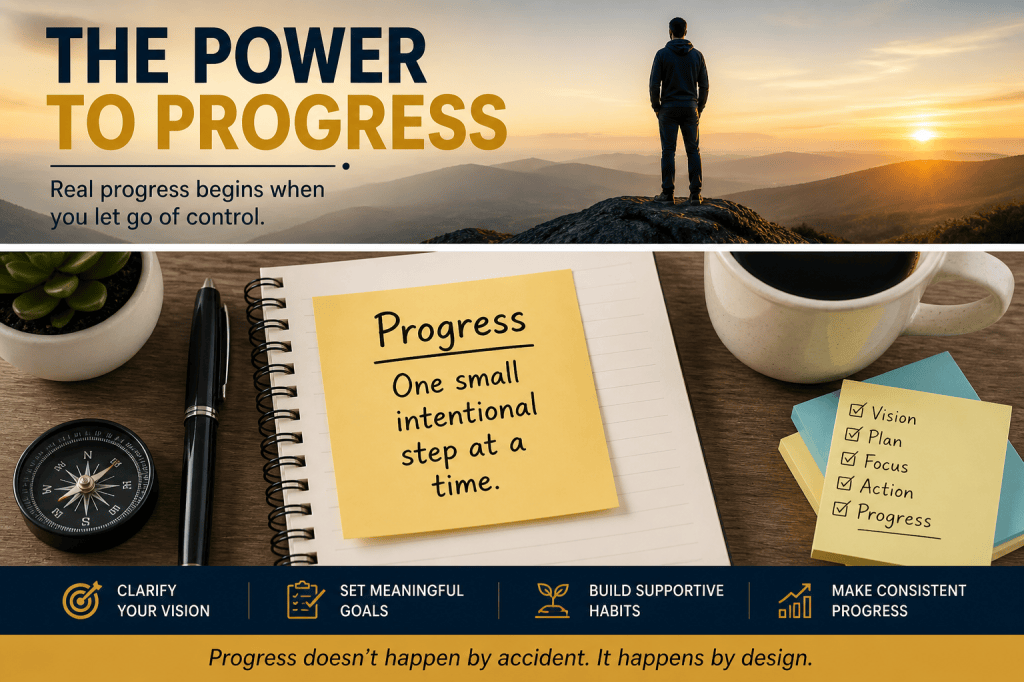
Progress does not happen by accident. It happens by design.
That is exactly why I created Focus and Flow, a self-improvement challenge designed to help you overcome resistance, clarify your vision, set meaningful goals, and build supportive habits and systems that help you make consistent progress.
If you are struggling to apply these ideas consistently, comment FOCUS and I will email you



Leave a Reply