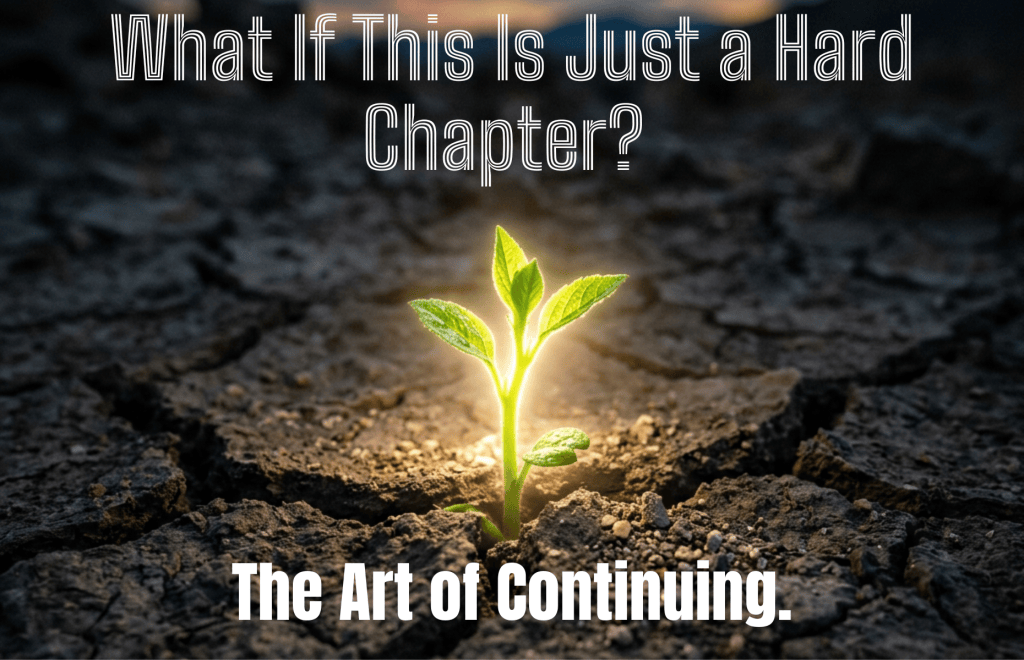
Most people assume that when life becomes difficult, they must be doing something wrong. They interpret resistance as a sign to quit, obstacles as signs to change direction, and challenges as evidence that they are on the wrong path.
But what if difficulty is actually a sign of progress?
What if this chapter is doing something in you before it does something for you?
Most people think that it is the most talented, disciplined, or intelligent people who succeed. But in reality, success often belongs to people who learn to adjust, adapt, and refuse to give up on their goals; those who learn how to continue despite difficult seasons.
Therefore, in this series, I want to teach you how to keep moving forward no matter what life throws your way. Over the next six weeks, I’ll use my six steps framework to show you not only how to survive difficult seasons, but also how to learn, grow, and become more resilient because of them.
But before we learn how to survive hard seasons it’s important to first understand that difficult seasons are a normal part of life.
So let’s begin here.
Challenges Are Normal
Growth begins in a place that looks like loss. When you plant a seed, you bury it beneath the soil. The seed must then break open in order for new life to grow.
Life works in the same way.
Every time you survive a difficult season, you grow. Every challenge you overcome gives you new knowledge, deeper experience, stronger character, and greater confidence. Essentially, before anything new grows, something old dies.
Yet most people don’t appreciate hardship.
James Clear writes in Atomic Habits, “You do not rise to the level of your goals. You fall to the level of your systems.”
In the same way, I believe that we “do not rise to the level of our success but fall to the level of our mindset and capacity”.
From this perspective you can understand why some people who achieve success (especially financial success) without going through the building process either cave in from the pressure of their success or lose everything in a few years. This is because they never developed the mindset, wisdom, system and character needed to sustain what they achieved.
Don’t skip the process.
Hard seasons develops both mindset and capacity. But most people don’t appreciate hardship. They try to avoid it, go around it, or find a shortcut through it. While that may seem easier in the moment, it robs them of the opportunity to build the capacity they will need for the future.
The mountaintop reveals what is already there but it is in the valley we grow. If resilience, discipline, and character were not built before success arrives, they won’t appear afterward.
Don’t Apply Permanent Solutions to Temporary Problems
Success is like an investment, and every investment moves in cycles. Some seasons are exciting and productive. Others are slow, uncomfortable, and filled with waiting. However, it is resilience in the waiting that separates those who eventually receive the reward from those who give up too soon.
And so many people give up too soon.
- When they have misunderstandings in their relationships, instead of trying to work through it, they end it.
- When they experience a setback in their business, they close it!
- When they don’t see a clear path towards their career goals, they change careers!
- When goals are not progressing fast enough, they abandon it.
That’s what I call applying a permanent solution to a temporary problem. As we established in the beginning, hard seasons are normal. And just like seasons, they change!
No one achieves anything worthwhile without enduring hard seasons.
It is important to understand that life is a process. Challenges will come and go. That is a fact of life! It is your character that withstands the hard seasons and enjoys the easy seasons.
Don’t Start Over. Continue.
I believe that one of the greatest purposes of a hard season is to build you into an unbreakable person. But if you make a life altering decision in the face of a temporary situation, you miss out on the opportunity for growth. You also have to live with the consequences of that choice for the rest of your life.
I was faced with this choice recently when I was struggling through a season in my PhD journey. Nothing was going as planned.
I was tired.
Frustrated.
Discouraged.
For the first time in a very long time, I seriously considered quitting.
Then God reminded me of everything I had already survived. He reminded me that I had completed a bachelor’s degree and a master’s degree before attempting a PhD. He reminded me of previous victories that empowered me, of the failures that taught me, and the challenges that strengthened me. He reminded me that I had developed the experience and the capacity to do hard things.
Then He gave me one simple phrase: Don’t start over. Continue.
Ironically, that phrase has become the heartbeat of my Focus & Flow program. It resonates with so many people because we all struggle with continuing when life becomes difficult.
God reminded me that it is better to try and fail than to run away from difficulty.
Although I believe He would not let me fail, He also reminded me that if I ever did fail, I should fail moving forward not running away.
That changed something inside me. I have failed at several things in my life. I have also succeeded at several things. But I have never knowingly quit something simply because it became difficult.
That is now part of my belief system.
I would rather fail trying than spend the rest of my life wondering what might have happened if I had continued.
And if something truly doesn’t work out despite my best efforts, I can still say with confidence:
“I tried. I learned. Now I can teach someone else from a place of real experience.”
And from my experience I can confidently say do not buy into the microwave philosophy. Stop wishing things would happen faster or life would become easier. Instead challenge yourself to become stronger by submitting to the process of growth and transformation.
The Art of Continuing
Over the last six years, I’ve walked through some incredibly difficult seasons.
Childbirth. COVID-19. Navigating office politics. Losing businesses. Living in isolation for almost two years while pursuing my PhD. Almost quitting that same PhD.
As I reflected on those experiences, I noticed a pattern.
In every difficult season I followed a similar sequence.
First, I survived.
Then I stepped back and reflected on what was happening—and who I was becoming.
Next, I strategized my next move.
Then I simplified my priorities.
After that, I systemized those priorities through routines, habits, and structures.
Finally, I fought to sustain those systems until I completed that season.
This pattern showed me that continuing is not a personality trait. It is a skill.
And like every skill, it can be learned.
The Six Principles of Continuing
- Survive — When life gets hard, your first responsibility is simply to survive.
- Step Back — Gain perspective and understand what is really happening.
- Strategize — Design your next move with intention.
- Simplify — Remove what no longer serves you and focus on what matters most.
- Systemize — Build routines, habits, and systems that support your goals.
- Sustain — Continue refining, protecting, and strengthening what works.
Because sometimes the answer isn’t to start over.
Sometimes the answer is simply…
Continue.

Leave a Reply